
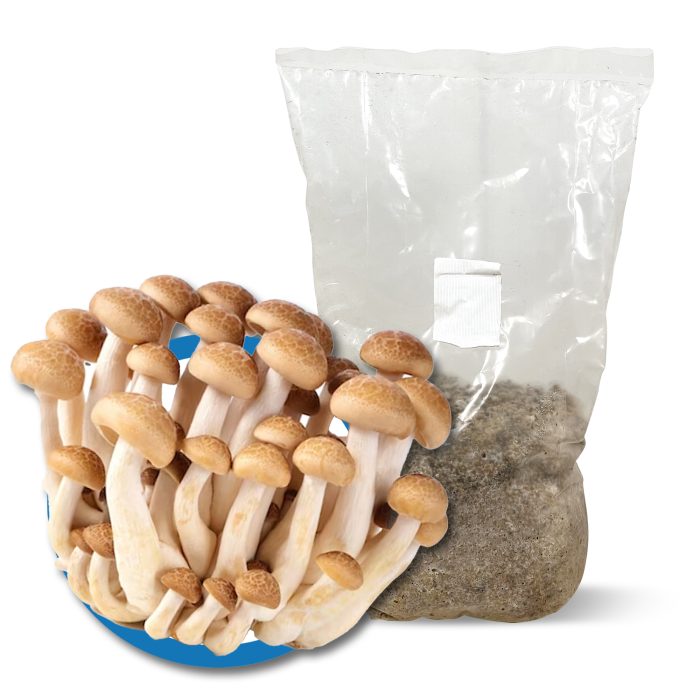
Mushroom Spawn Bags 1.7kg – Brown Beech (Hypsizigus Tessellatus) made to order
$59.95
Available on back-order
Description
🤎 Brown Beech Mushroom Spawn Guide (Hypsizygus tessulatus)
Ready to step up your mushroom growing game? The Brown Beech Mushroom (Hypsizygus tessulatus)—also known commercially as Buna-shimeji or the brown clamshell mushroom—is an incredible gourmet edible!
Originally native to East Asia where they naturally grow on hardwood beech trees, this is the classic, wild-type brown variation. It produces absolutely stunning, tightly packed commercial clusters of small, thin mushrooms with beautifully pigmented brown caps that pack a wonderfully nutty and savory flavor, making them incredibly popular in Asian cuisine.
Please note: Beech mushrooms require a bit more patience than your standard oysters, as they need a much longer incubation period. They are also best grown on sterilized or super-pasteurized supplemented sawdust blocks only!
🌾 Recommended Substrates To get those famous, abundant clusters, this wood-loving strain requires a high-nutrient diet! We highly recommend:
-
Master’s Mix (a 50/50 blend of hardwood sawdust and soy hull pellets)
-
Hardwood sawdust heavily supplemented with nutrients (like oat bran, wheat bran, or soybean meal) at a rate of 10% to 30%.
🛠️ How to Prepare Your Substrate & Inoculate Because Brown Beech mushrooms thrive on highly nutritious supplemented substrates, standard hot-water pasteurization is not enough. You will need to treat this like an advanced grow!
-
Hydration: Before processing, ensure your bulk substrate mixture is thoroughly wetted to a 60% moisture level.
-
Sterilization is Key: Your supplemented substrate blocks should be fully sterilized in a pressure cooker at 15 PSI for 2.5 hours, or “super pasteurized” by steaming them at atmospheric pressure for 10 to 12 hours.
-
Clean Inoculation: Because you are mixing your spawn into fully sterilized material, you must be extremely clean! Always inoculate your cooled blocks in front of a laminar flow hood or inside a Still Air Box (SAB) wiped down with 70% isopropyl alcohol.
🧫 Incubation (Colonizing Your Block) Once you have cleanly mixed your spawn into your prepared, sterile substrate and sealed your bags, it is time to let the mycelium take over!
-
Temperature: Store your inoculated bags in a clean, dark space with stable temperatures between 16-20°C.
-
Fresh Air: The growing mycelium needs to breathe! Ensure your incubation room has good ventilation, aiming for ideally one room air change per hour.
-
The Golden Rule—Patience!: Beech mushrooms require a significantly longer incubation time compared to fast-moving Oysters. Even after the block looks fully white, it needs extra weeks to consolidate and mature before it is truly ready to fruit. Don’t rush it!
🌤️ Best Fruiting Environment Brown Beech mushrooms are top-fruiters! You will need to cut the top of the bag open to allow the clusters to grow straight up.
-
Temperature: Once fully consolidated and ready to fruit, they require a cooler temperature drop to trigger pinning. Aim for a temperature range of 13-18°C.
-
Light: Place your fully white block somewhere with enough natural, indirect light to read a book by. Good lighting is especially important for the Brown Beech, as it helps trigger healthy pin development and brings out that rich, beautiful brown pigmentation in the caps!
-
Humidity: Keep it incredibly high (80-90%+). Because they fruit from the exposed top of the block, they need consistent environmental moisture to form healthy pinsets.
-
Fresh Air: To get beautifully proportioned stems and caps, aim for high fresh air exchange (6-8+ room air changes per hour).
🍄 Tips & Harvesting
-
Inoculation Rate: Because you are mixing your spawn into fully sterilized material in a highly clean environment, you only need an inoculation rate of 3% to 5% by weight. Your 1.7kg spawn bag will go a very long way!
-
Fun Mycological Fact: This fungus is often confused with Hypsizygus ulmarius, the Elm Oyster! Interestingly, a radical alternative view based on recent ITS DNA barcoding suggests that all members of this genus might actually be the exact same species.
-
When to pick: Harvest the entire bunch at once! The best time to pick is when the stems are elongated and the small brown caps have slightly expanded but are still convex (dome-shaped). Gently twist and pull the entire cluster away from the block, then trim the base before tossing them into your favorite stir-fry or soup.
Please note this culture is sold with our Mushroom Spawn and Cultures sale agreement. By purchasing you agree to this agreement
Related products
- Free shipping
- Free shipping
- Free shipping
- Free shipping


Reviews
There are no reviews yet